

Extracts of Bryophyllum pinnatum and Vincetoxicum rossicum synergize with standard antibiotics against multidrug-resistant gram-negative bacteria
Article Sidebar
Main Article Content
Abstract
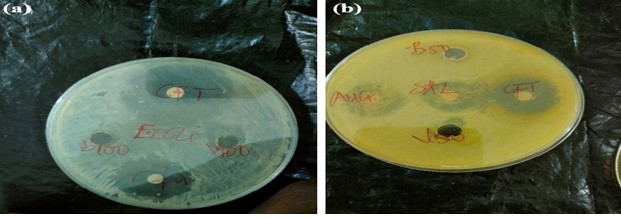
The increasing prevalence of antibiotic-resistant Gram-negative bacteria has intensified the need for alternative antimicrobial agents. This study evaluated the antibacterial activities of ethanolic extracts of Bryophyllum pinnatum and Vincetoxicum rossicum against clinical isolates of Escherichia coli, Klebsiella pneumoniae, and Salmonella typhi. The leaves were extracted using 95% ethanol, and their antibacterial efficacy was assessed using the agar well diffusion method on Mueller-Hinton agar, with standard antibiotics (Amoxicillin-Clavulanate, Cefuroxime, and Ceftazidime) as controls. Zones of inhibition were measured, and data were analyzed using two-way ANOVA with a P < 0.05 significance level. The ethanolic extract of V. rossicum at 100% concentration demonstrated significant antibacterial activity against E. coli (18.33 ± 0.33 mm), K. pneumoniae (15.33 ± 0.66 mm), and S. typhi (13.33 ± 0.33 mm). In B. pinnatum, the ethanolic extract at 100% concentration was active against E. coli (14.67 ± 0.33 mm) and K. pneumoniae (14.67 ± 0.90 mm) but showed no effect on S. typhi. Among the antibiotics, Ceftazidime produced the highest inhibition against E. coli (34.00 ± 0.58 mm), followed by Cefuroxime (29.75 ± 0.86 mm) and Amoxicillin–Clavulanate (28.25 ± 0.75 mm). Notably, synergistic effects against the bacterial isolates were observed between the ethanolic extract of V. rossicum and Ceftazidime (53.00 mm), and between Cefuroxime and Ceftazidime (45.00 mm). These findings suggest that ethanolic extracts of B. pinnatum and V. rossicum may serve as complementary agents in the treatment of infections caused by Gram-negative bacteria.
Article Details

This work is licensed under a Creative Commons Attribution-NonCommercial 4.0 International License.
References
1. Nwobodo, DC, Ugwu, MC, Anie, CO, Al‐Ouqaili, MTS, Ikem, JC, Chigozie, UV, Saki, M. Antibiotic resistance challenges. J. Clin. Lab. Anal. 2022; 36(9): e24655.
2. Ahmed SK, Hussein S, Qurbani K, Ibrahim RH, Fareeq A, Mahmood KA, Mohamed MG. Antimicrobial resistance: impacts, challenges, and future prospects. J. Med. Surg. Public Health. 2024; 2:100081.
3. Mancuso G, Midiri A, Gerace E, Biondo C. Bacterial antibiotic resistance. Pathogens. 2021;10(10):1310.
4. World Health Organization. Antimicrobial resistance. WHO; 2023.
5. Richards DM, Brogden RN. Ceftazidime review. Drugs. 1985;29(2):105–161.
6. Omole AE, Awosika AO, Patel P. Cefuroxime. [Updated 2024 Jan 11]. StatPearls [Internet]. Treasure Island (FL): StatPearls Publishing. 2025.
7. Basavegowda N, Baek K. Combination strategies of antimicrobials: an efficient tool for pathogen inactivation. Biomedicines. 2022;10(9):2219.
8. Willie P, Uyoh EA, Aikpokpodion PO. Gas chromatography-mass spectrometry (GC-MS) assay of bio-active compounds and phytochemical analyses in three species of Apocynaceae. Pharmacogn. J. 2021;13(2):383–392.
9. Chaachouay N, Zidane L. Plant-derived natural products in drug discovery. Drugs Drug Candidates. 2024; 3(1):184–207.
10. Vaou N, Stavropoulou E, Voidarou C, Tsigalou C, Bezirtzoglou E. Medicinal plant antimicrobial activity. Microorganisms. 2021;9(10):2041.
11. Fernandes JM, Cunha LM, Azevedo EP, Lourenço EM, Fernandes-Pedrosa MF, Zucolotto SM. Kalanchoe laciniata and Bryophyllum pinnatum review. Rev. Bras. Farmacogn. 2019; 29(4):529–558.
12. Faluyi O. Nigeria’s medicinal plant: Bryophyllum pinnatum (abamoda). Punch Newspapers; 2021.
13. Kumar P, Malik S, Dubey KK. Bryophyllum pinnatum: a review on medicinal benefits and potent bioactive molecules. Curr. Bioact. Compd. 202;16(7):978-92.
14. Averill KM, DiTommaso A, Mohler CL, Milbrath LR. The invasive swallow-worts: biology and management. Int Allelopathy Congr. 2008; 71.
15. Mogg C, Petit P, Cappuccino N, Durst T, Arnason JT. Antibiotic properties of Vincetoxicum rossicum. Biochem Syst. Ecol. 2008; 36(5–6):383–391.
16. Charanchi MUSA, Kalgo ZM. Incidence of typhoid fever in Zamfara State, Nigeria. Glob Acad J Med Sci. 2025; 7(4):168–172.
17. Ravi N, & Ayando OD. Risk Perception, Behavior, and Knowledge of Typhoid Fever Diagnosis, Treatment, and Vaccination: Insights from Patients in Kano, Nigeria. medRxiv, 2024; 11.
18. Mueller M, Tainter CR. Escherichia coli infection. InStatPearls [Internet]. 2025.
19. World Health Organization. WHO warns of widespread resistance to common antibiotics. WHO; 2025
20. Asia Pacific Economic Cooperation (APEC). Laboratory guide: methodologies for antimicrobial susceptibility testing. APEC; 2020.
21. CLSI. Performance standards for antimicrobial disk susceptibility tests—12th ed. CLSI; 2015.
22. Pakpour N, Horgan S. Antibiotic susceptibility testing. CSU; 2021.
23. Prince A, Roy S, McDonald D. Antimicrobial synergy of natural substances. Microbiol Spectr. 2022;10(3): e0235721.
24. McMurray R, Ball M, Tunney M, Corcionivoschi N, Situ C. Antibacterial activity of plant extracts. Microorganisms. 2020; 8(6):962.
25. Elisha IL, Botha FS, McGaw LJ, Eloff JN. Antibacterial activity of plant extracts. BMC Complement Altern Med. 2017; 17(1).
26. Onivogui G, Letsididi R, Diaby M, Wang L, Song Y. Extraction solvents and antimicrobial activity. Asian Pac J Trop Biomed. 2016; 6(1):20–25.
27. Borges A, José H, Homem V, Simões M. Antimicrobial potential of plant extracts. Antibiotics. 2020; 9(2):48.
28. Lee J, Jayakody J, Kim J, Jeong J, Choi K, Ryu B. Solvent choice and bioactive extraction. Foods. 2024; 13(19):3151.
29. Rita NN, Chidimma OP, Oluebebe NA, Chisom OG, Kingsley CI. Solvent-dependent antimicrobial and phytochemical extracts of Curcuma longa against clinical pathogens. Tropical Journal of Phytochemistry and Pharmaceutical Sciences. 2025 Sep 7;4(8):334-7.
30. Nawaz H, Shad MA, Rehman N, Andaleeb H, Ullah N. Solvent polarity and extraction yield. Braz J Pharm Sci. 2020;56.
31. Bitwell C, Indra SS, Luke C, Kakoma MK. Review of extraction techniques for phytochemicals. Sci Afr. 2023;19: e01585.
32. Huy, T.X.N. Overcoming Klebsiella pneumoniae antibiotic resistance: new insights into mechanisms and drug discovery. Beni-Suef Univ J Basic Appl Sci. 2024; 13, 13.
33. Ghosh, I., Khanra, M., Banerjee, T., Sar, S., Chakraverty, R., Halder, A. K., Chaki, R., & Ghosh, N. Phytochemicals as Therapeutic Agents for ESKAPE Pathogens. Current Indian Science, 2024; 03
34. Nwadinigwe N. Antimicrobial activities of Bryophyllum pinnatum stem. Afr J Biotechnol. 2011;10(72).
35. Okoye EI, Anyaegbunam LC, Obi ZC, Ibemenuga KN. Pharmaceutical constituents of ‘Bryophyllum pinnatum. J Health Med Nurs. 2015; 16:37–41.
36. Ojeleye F, Oyekunle O, Isama T, John J, Markus T, & Orakpoghenor O. Antimicrobial activity of Bryophyllum pinnatum. Eur J Microbiol Infect Dis. 2024; 1(2):13.
37. Soto SM. Efflux pumps in antibiotic resistance. Virulence. 2013;4(3):223–229.
38. Huang L, Wu C, Gao H, Xu C, Dai M, Hao H, Cheng G. Bacterial multidrug efflux pumps. Antibiotics (Basel). 2022; 11(4):520.
39. Angelini P. Plant-derived antimicrobials and their crucial role in combating antimicrobial resistance. Antibiotics (Basel). 2024;13(8):746.