

Synthesis, Characterization and Antimicriobial Activity of 1, 2-Bis ((E)-3-Phenylallylidene) Hydrazine and Its Metal Complexes
Article Sidebar
Main Article Content
Abstract
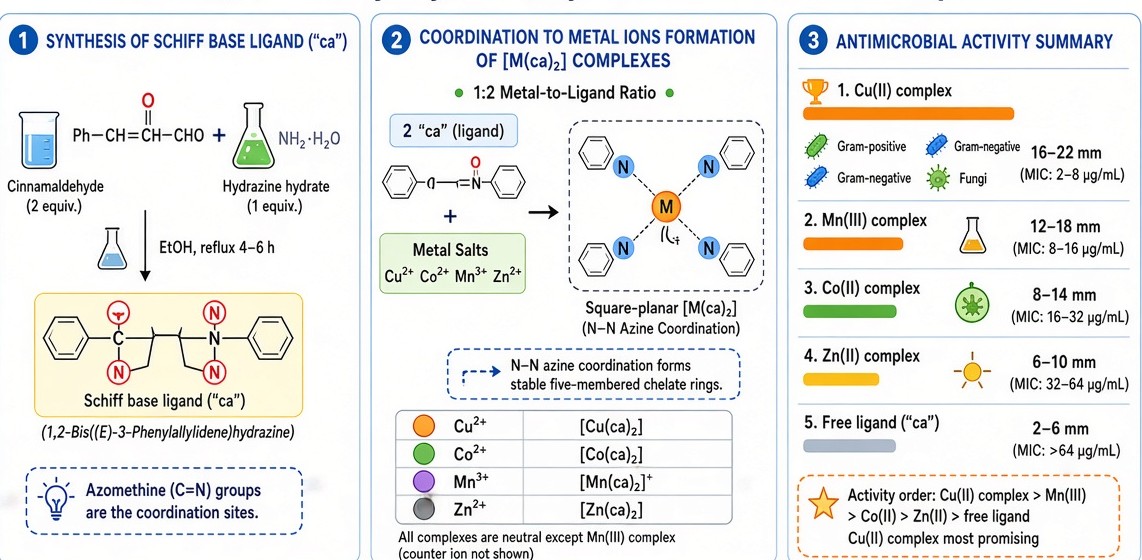
Schiff bases and associated transition-metal complexes have garnered significant interest because of their wide range of biological activity and structural adaptability. The growing problem of antibiotic resistance highlights the urgent need to discover and develop alternative antimicrobial agents. In this work, cinnamaldehyde was condensed with hydrazine hydrate to form 1,2-bis (E-3-phenylallylidene)hydrazine (ca), which was then coordinated with Cu(II), Co(II), Mn(III), and Zn(II) ions. Metal analysis, infrared spectroscopy, UV-visible spectroscopy, and magnetic susceptibility measurements were used to characterise the synthesised ligand and its metal complexes. Spectroscopic data confirmed coordination through the azine nitrogen atoms, yielding metal complexes with a 1:2 metal-to-ligand ratio. Magnetic and electronic spectra supported square-planar coordination in the complexes. Using broth dilution and agar diffusion techniques, we assessed the antibacterial properties of the ligand and its complexes against specific strains of fungi, Gram-positive bacteria, and Gram-negative bacteria. Metal complexation greatly increased the ligand’s biological activity. The Cu(II) complex, which produced the biggest inhibition zones and the lowest minimum inhibitory concentration (MIC) and minimum microbicidal concentration (MMC) values among the synthesised compounds, had the strongest antibacterial action. Increased lipophilicity and improved interaction of the metal complexes with microbial targets after chelation explain the increased activity. These results indicate that the Cu(II) complex is the most promising option for additional biological research and show that coordination of the Schiff base with transition metal ions enhances its antibacterial activity.
Article Details

This work is licensed under a Creative Commons Attribution-NonCommercial 4.0 International License.
References
1. Al Zoubi W, Mohamed SG, Al-Hamdani AAS, Ko YG. Acyclic and cyclic imines and their metal complexes: Recent progress in biomaterials and corrosion applications. RSC Adv. 2018;8:23294–23318. doi: https://doi.org/10.1039/C8RA01890A
2. Malav R, Ray S. Recent advances in the synthesis and versatile applications of transition metal complexes featuring Schiff base ligands. RSC Adv. 2025;15(28):22889–22914. doi: https://doi.org/10.1039/d5ra03626g
3. Housecroft CE, Sharpe AG. Inorganic Chemistry. 5th ed. Pearson; 2018. Available from: https://www.pearson.com/en-gb/subject-catalog/p/inorganic-chemistry/P200000003504/9781292134147
4. Miessler GL, Fischer PJ, Tarr DA. Inorganic Chemistry. 5th ed. Pearson; 2014.
5. Golbedaghi R, Tabatabaei SM, Esmaeili S, Fausto R. Biological applications of macrocyclic Schiff base ligands and their metal complexes: A survey of the literature (2005–2019). Appl Organomet Chem. 2020; 34(10):e5927. doi: https://doi.org/10.1002/aoc.5884
6. Ceramella J, Iacopetta D, Catalano A, Cirillo F, Lappano R, Sinicropi MS. A review on the antimicrobial activity of Schiff bases: Data collection and recent studies. Antibiotics. 2022;11(2):191. doi: https://doi.org/10.3390/antibiotics11020191
7. Jorge J, Del Pino Santos KF, Timóteo F, Piva Vasconcelos RR, Ayala Cáceres OI, et al. Recent advances on the antimicrobial activities of Schiff bases and their metal complexes: An updated overview. Curr Med Chem. 2024;31(17):2330–2344. doi: https://doi.org/10.2174/0929867330666230224092830
8. Kostova I, Saso L. Advances in research of Schiff-base metal complexes as potent antioxidants. Curr Med Chem. 2013;20(36):4609-4632. doi: https://doi.org/10.2174/092986713804499262
9. Tadele KT, Tsega TW. Schiff bases and their metal complexes as potential anticancer candidates: A review of recent works. Anticancer Agents Med Chem. 2019;19(15):1786–1795. doi: https://doi.org/10.2174/1871520619666190227171716
10. Gupta KC, Sutar AK. Catalytic activities of Schiff base transition metal complexes. Coord Chem Rev. 2008;252(12–14):1420–1450. doi: https://doi.org/10.1016/j.ccr.2007.09.005
11. Kumar S, Dhar DN, Saxena PN. Applications of metal complexes of Schiff bases—A review. J Sci Ind Res. 2009;68:181–187. Available from: https://www.researchgate.net/profile/Manoj-Jadhao/post/What_are_the_medicinal_applications_of_Schiff_bases_or_their_metal_complexes/attachment/59d62f5ec49f478072e9fe9c/AS%3A273585824829440%401442239351526/download/schiff+base+review.pdf
12. da Silva CM, da Silva DL, Modolo LV, Alves RB, de Resende MA, Martins CVB, et al. Schiff bases: A short review of their antimicrobial activities. J Adv Res. 2011;2(1):1–8. doi: https://doi.org/10.1016/j.jare.2010.05.004
13. Przybylski P, Huczyński A, Pyta K, Brzezinski B, Bartl F. Biological properties of Schiff bases and azo derivatives of phenols. Curr Org Chem. 2009;13(2):124–148. doi: https://doi.org/10.2174/138527209787193774
14. Onyeyilim EL, Ezeokonkwo MA, Ugwu DI, Uzoewulu CP, Eze FU, et al. Carbohydrazide analogues: A review of synthesis and biological activities. Mini Rev Med Chem. 2022;22(4):661–682. doi: https://doi.org/10.2174/1389557521666210831154935
15. Nath BD, Islam MM, Karim MR, Rahman S, Shaikh MAA, et al. Recent progress in metal-incorporated acyclic Schiff-base derivatives: Biological aspects. ChemistrySelect. 2022;7:e202104290. doi: https://doi.org/10.1002/slct.202104290
16. Tweedy BG. Plant extracts with metal ions as potential antimicrobial agents. Phytopathology.1964;54:910–914.Availablefrom: https://archive.org/details/sim_phytopathology_1964_54_cumulative-index/page/n1/mode/2up
17. Iacopetta D, Ceramella J, Catalano A, Mariconda A, Giuzio F, Saturnino C, et al. Metal complexes with Schiff bases as antimicrobials and catalysts. Inorganics. 2023;11(8):320. doi: https://doi.org/10.3390/inorganics11080320
18. Doyle AA, Stephens JC. A review of cinnamaldehyde and its derivatives as antibacterial agents. Fitoterapia. 2019;139:104405. doi: https://doi.org/10.1016/j.fitote.2019.104405
19. Tung Y-T, Chua M-T, Wang S-Y, Chang S-T. Anti-inflammation activities of essential oil and its constituents from indigenous cinnamon (Cinnamomum osmophloeum) twigs. Bioresour Technol. 2008;99(9):3908–3913. doi: https://doi.org/10.1016/j.biortech.2007.07.050
20. Lu J, Zhang K, Nam S, Anderson RA, Jove R, Wen W. Novel angiogenesis inhibitory activity in cinnamon extract blocks VEGFR2 kinase and downstream signaling. Carcinogenesis. 2010;31(3):481–488. doi: https://doi.org/10.1093/carcin/bgp310
21. Rao PV, Gan SH. Cinnamon: A multifaceted medicinal plant. Evid Based Complement Alternat Med. 2014;2014:642942. doi: https://doi.org/10.1155/2014/642942
22. Wang H, Yuan H, Li S, Li Z, Jiang M. Synthesis, antimicrobial activity of Schiff base compounds of cinnamaldehyde and amino acids. Bioorg Med Chem Lett. 2016;26(3):809–813. doi: https://doi.org/10.1016/j.bmcl.2015.12.089
23. Rollas S, Küçükgüzel ŞG. Biological activities of hydrazone derivatives. Molecules. 2007;12(8):1910–1939. doi: https://doi.org/10.3390/12081910
24. Raczuk E, Dmochowska B, Samaszko-Fiertek J, Madaj J. Different Schiff bases—Structure, importance and classification. Molecules. 2022;27(3):787. doi: https://doi.org/10.3390/molecules27030787
25. Bharti SK, Nath G, Tilak R, Singh SK. Synthesis, antibacterial and antifungal activities of some novel Schiff bases containing 2,4-disubstituted thiazole moiety. Eur J Med Chem. 2010;45(2):651–660. doi: https://doi.org/10.1016/j.ejmech.2009.11.008
26. Nakamoto K. Infrared and Raman Spectra of Inorganic and Coordination Compounds. 6th ed. John Wiley & Sons; 2009. Available from: https://books.google.com/books?
hl=en&lr=&id=IQZKdQ1rSKQC&oi=fnd&pg=PR5&dq=Nakamoto+K.+Infrared+and+Raman+Spectra+of+Inorganic+and+Coordination+Compounds.+6th+ed.+John+Wiley+%26+Sons%3B+2009&ots=vujwpbsl55&sig=Umc0X6DyGoP_gOfL0VOHuSYVB04
27. Pavia DL, Lampman GM, Kriz GS, Vyvyan JR. Introduction to Spectroscopy. 5th ed. Cengage Learning; 2015. Available from: https://www.cengage.com/c/introduction-to-spectroscopy-5e-pavia/9781285460123/
28. Dhanaraj CJ, Johnson J, Joseph J, Joseyphus RS. Quinoxaline-based Schiff base transition metal complexes: A review. J Coord Chem. 2013;66(8):1416–1450. doi: https://doi.org/10.1080/00958972.2013.782008
29. Abu-Dief AM, Mohamed IMA. A review on versatile applications of transition metal complexes incorporating Schiff bases. Beni-Suef Univ J Basic Appl Sci. 2015;4(2):119–133. doi: https://doi.org/10.1016/j.bjbas.2015.05.004
30. Lever ABP. Inorganic Electronic Spectroscopy. 2nd ed. Elsevier; 1984. Available from: https://pascal-francis.inist.fr/vibad/index.php?action=getRecordDetail&idt=9094331
31. Cotton FA, Wilkinson G, Murillo CA, Bochmann M. Advanced Inorganic Chemistry. 6th ed. John Wiley & Sons; 1999. Available from: https://www.wiley.com/en-us/Advanced+Inorganic+Chemistry%2C+6th+Edition-p-9780471199571