

In-vitro Antioxidant and Antidiabetic Activities and Ex-vivo Hepatic Effects of Psidium guajava and Ocimum gratissimum Methanol Leaf Extracts
Article Sidebar
Main Article Content
Abstract
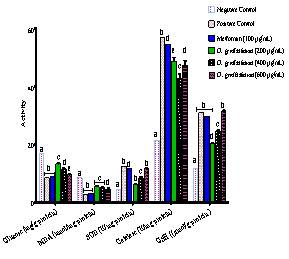
Diabetes mellitus is a metabolic disorder characterized by impaired glucose regulation and associated oxidative stress, creating a need to explore plant-derived compounds with potential antioxidant and antidiabetic properties. This study evaluated the in-vitro antioxidant and antidiabetic activities of methanol leaf extracts of Psidium guajava and Ocimum gratissimum and their ex-vivo hepatic effects. Antioxidant activity was assessed using 2,2-diphenyl-1-picrylhydrazyl (DPPH) radical scavenging, total antioxidant capacity (TAC), reducing power, and hydroxyl radical scavenging assays. α-Amylase and α-glucosidase inhibition were also determined for the invitro antidiabetic activities. Ex-vivo hepatic effects were assessed at 200, 400, and 600 µg/mL in a high-glucose Krebs–Henseleit buffer model, using metformin as a reference treatment. Calculated IC₅₀ values for O. gratissimum and P. guajava, respectively, were 152.94 and 200.00 µg/mL for DPPH scavenging, 686.96 and 847.62 µg/mL for TAC, and 428.57 and 930.20 µg/mL for hydroxyl radical scavenging. For α-amylase inhibition, the corresponding values were 843.34 and 411.32 µg/mL, while those for α-glucosidase inhibition were 553.85 and 486.79 µg/mL. DPPH scavenging reached 86% and 81%, respectively, while reducing power reached 75% and 74%. Maximum α-amylase inhibition was 50% for O. gratissimum and 89% for P. guajava, whereas α-glucosidase inhibition reached 79% and 84%, respectively. Both extracts reduced hepatic glucose and malondialdehyde concentrations and significantly increase superoxide dismutase, catalase, and reduced glutathione activities. At 600 µg/mL, the activities of these enzymes and concentration of reduced glutathione were compared favourably with metformin. The findings demonstrate antioxidant and carbohydrate-digestive enzyme inhibitory activities, supporting further investigation of both extracts.
Article Details

This work is licensed under a Creative Commons Attribution-NonCommercial 4.0 International License.
References
1. Genitsaridi I, Salpea P, Salim A, Sajjadi SF, Tomic D, James S. IDF Diabetes Atlas: global, regional, and national diabetes prevalence estimates for 2024 and projections for 2050. Lancet Diabetes Endocrinol. 2026;14(2):149–156.
2. Khalilov R, Abdullayeva S. Mechanisms of insulin action and insulin resistance. Adv Biol Earth Sci. 2023;8(2):165.
3. Rao TR, Tejomurtula GN. Diabetes mellitus: a review. Int J Med Sci Pharma Res. 2024;10(2):5–9.
4. Singh H, Singh R, Singh A, Singh H, Singh G, Kaur S. Role of oxidative stress in diabetes-induced complications and their management with antioxidants. Arch Physiol Biochem. 2024;130(6):616–641.
5. Chen X, Xie N, Feng L, Huang Y, Wu Y, Zhu H. Oxidative stress in diabetes mellitus and its complications: From pathophysiology to therapeutic strategies. Chin Med J (Engl). 2025;138(01):15–27.
6. Bandodkar VV, Moger VS, Baliga P. Antioxidant Defense Mechanisms: Enzymatic and Non-Enzymatic. In: The Role of Reactive Oxygen Species in Human Health and Disease. IGI Global Scientific Publishing. 2025; 1:43–80. Doi: 10.4018/979-8-3693-7919-6.ch002
7. Islam MN, Rauf A, Fahad FI, Emran T Bin, Mitra S, Olatunde A. Superoxide dismutase: an updated review on its health benefits and industrial applications. Taylor Fr. 2022;62(26):7282–7300. doi:10.1080/10408398.2021.1913400 PubMed PMID: 33905274.
8. Bey A, ArrvinD A, Yadav PK, SAreen S. Malondialdehyde: A Toxic Stress Marker for Periodontitis. J Clin Diagnostic Res. 2024;18(3):ZE01–ZE05. Doi: 10.7860/JCDR/2024/68440.19195.
9. Carmo de Carvalho e Martins MD, da Silva Santos Oliveira AS, da Silva LAA, Primo MGS, de Carvalho Lira VB. Biological indicators of oxidative stress [malondialdehyde, catalase, glutathione peroxidase, and superoxide dismutase] and their application in nutrition. In: Patel VB, Preedy VR, editors. Biomarkers in Nutrition. Cham: Springer; 2022. 1:1–25. Doi: 10.1007/978-3-030-81304-8_49-1.
10. Scoditti E, Sabatini S, Carli F, Gastaldelli A. Hepatic glucose metabolism in the steatotic liver. Nat Rev Gastroenterol Hepatol. 2024;21(5):319–334.
11. González P, Lozano P, Ros G, Solano F. Hyperglycemia and Oxidative Stress: An Integral, Updated and Critical Overview of Their Metabolic Interconnections. Int J Mol Sci. 2023;24(11). doi:10.3390/ijms24119352 PubMed PMID: 37298303.
12. Pannucci E, Spagnuolo L, De Gara L, Santi L, Dugo L. Phenolic compounds as preventive and therapeutic agents in diabetes-related oxidative stress, inflammation, advanced glycation end-products production and insulin sensitivity. Discov Med. 2023;35(178).
13. Joshi DM, Pathak SS, Banmare S, Bhaisare SS. Review of phytochemicals present in Psidium guajava plant and its mechanism of action on medicinal activities. Cureus. 2023; 15(10):e46364. Doi: 10.7759/cureus.46364
14. Worku LA, Zebeaman M, Bachheti RK, Bachheti A, Rawat YS, Husen A. Ethnomedical use, phytochemistry, nutritional profile, commercial potential, and other potential applications of Psidium guajava (guava). J Food Qual. 2024;2024(1):6076403.
15. Vanjarapu HD, Dukkipati S, Pandy V. A review on phytochemical, biological, and pharmacological effects of Psidium guajava Linn. (Guava). Int J Pharm Sci Nanotechnol. 2024; 17(1):7173–7182. Doi: 10.37285/ijpsn.2024.17.1.7..
16. Möwes M, Kandanda GK, Nangolo LN, Shafodino FS, Mwapagha LM. Qualitative phytochemical profiling, and in vitro antimicrobial and antioxidant activity of Psidium guajava (Guava). PLoS One. 2025;20(4):e0321190.
17. Huynh HD, Nargotra P, Wang HMD, Shieh CJ, Liu YC, Kuo CH. Bioactive compounds from guava leaves (Psidium guajava L.): characterization, biological activity, synergistic effects, and technological applications. Molecules. 2025; 30(6):1278. Doi: 10.3390/molecules30061278.
18. Ojewumi ME, Babatunde DE, Orjiakor TG, Ojewumi EO, Olawale-Success OO. Exploring the therapeutic potential of Ocimum gratissimum extracts against microbial infections: A comprehensive review. Med India. 2024; 3(2):45–57. Doi: 10.25259/MEDINDIA_11_2024
19. Maphetu N, Unuofin JO, Oladipo AO, Lebelo SL. Ocimum gratissimum: Chemical composition, phytochemical properties, antioxidants, and pharmacological activities: A review. Plants. 2026; 15(11):1662. Doi: 10.3390/plants15111662.
20. Ugbogu OC, Emmanuel O, Agi GO, Ibe C, Ekweogu CN, Ude VC. A review on the traditional uses, phytochemistry, and pharmacological activities of clove basil (Ocimum gratissimum L.). cell.com NnannaHeliyon, 2021•cell.com. 2021: 1;7(11). doi:10.1016/J.HELIYON.2021.E08404
21. Chanda S V, Kaneria MJ. Optimization of conditions for the extraction of antioxidants from leaves of Syzygium cumini L. using different solvents. Food Anal Methods. 2012;5(3):332–338.
22. Blois MS. Antioxidant determinations by the use of a stable free radical. Nature. 1958; 181(4617):1199–1200. Doi: 10.1038/1811199a0
23. Prieto P, Pineda M, Aguilar M. Spectrophotometric quantitation of antioxidant capacity through the formation of a phosphomolybdenum complex: specific application to the determination of vitamin E. Anal Biochem. 1999;269(2):337–341.
24. Oyaizu M. Studies on products of browning reaction antioxidative activities of products of browning reaction prepared from glucosamine. Japanese J Nutr Diet. 1986;44(6):307–315.
25. Ouyang Q, Kou F, Zhang N, Lian J, Tu G, Fang Z. Tea polyphenols promote Fenton-like reaction: pH self-driving chelation and reduction mechanism. Chem Eng J. 2019;366:514–522.
26. Ting L, Zhang XD, Song YW, Liu JW. A microplate-based screening method for alpha-glucosidase inhibitors. Chin J Clin Pharmacol Ther. 2005; 10(10):1128–1134.
27. Bendelow VM. Modified procedure for the determination of diastatic activity and α-amylase activity. J Inst Brew. 1963; 69(6):467–472. Doi: 10.1002/j.2050-0416.1963.tb01954.x.
28. Yakubu MT, Akanji MA, Oladiji AT. Aphrodisiac potentials of the aqueous extract of Fadogia agrestis (Schweinf. Ex Hiern) stem in male albino rats. Asian J Androl. 2005;7(4):399–404. doi:10.1111/j.1745-7262.2005.00052.x PubMed PMID: 16281088.
29. Halliwell B, Gutteridge JMC. Free radicals in biology and medicine. Oxford university press; 2015:905
30. Thompson AL, Lim-Fraser MYC, Kraegen EW, Cooney GJ. Effects of individual fatty acids on glucose uptake and glycogen synthesis in soleus muscle in vitro. Am J Physiol Metab. 2000;279(3):E577–584.
31. Trinder P. Determination of Glucose in Blood using Glucose Oxidase with an alternative oxygen acceptor. Ann. din. Biochem. 1969;6(1):24- 27 https://doi.org/10.1177/000456326900600108
32. Gornall AG, Bardawill CJ, David MM. Determination of serum proteins by means of the biuret reaction. J biol Chem. 1949;177(2):751–766.
33. Botsoglou NA, Fletouris DJ, Papageorgiou GE, Vassilopoulos VN, Mantis AJ, Trakatellis AG. Rapid, sensitive, and specific thiobarbituric acid method for measuring lipid peroxidation in animal tissue, food, and feedstuff samples. J Agric Food Chem. 1994;42(9):1931–1937.
34. Sinha AK. Colorimetric assay of catalase. Anal Biochem. 1972;47(2):389–394.
35. Tietze F. Enzymic method for quantitative determination of nanogram amounts of total and oxidized glutathione: applications to mammalian blood and other tissues. Anal Biochem. 1969;27(3):502–522.
36. Bilal K, Mehboob F, Akhtar N, Mirza IA, Okla MK, Dar MJ. Wound healing, antioxidant and antibacterial activities of polyphenols of Psidium guajava L. leaves. South African J Bot. 2024,1;165:538–551. doi:10.1016/J.SAJB.2023.12.026
37. Zahin M, Ahmad I, Aqil F. Antioxidant and antimutagenic potential of Psidium guajava leaf extracts. Taylor Fr Zahin, I Ahmad, F AqilDrug Chem Toxicol 2017•Taylor Fr. 2017;3;40(2):146–153. doi:10.1080/01480545.2016.1188397 PubMed PMID: 27268266.
38. Juan CA, Pérez de la Lastra JM, Plou FJ, Pérez-Lebeña E. The chemistry of reactive oxygen species (ROS) revisited: Outlining their role in biological macromolecules (DNA, lipids and proteins) and induced pathologies. Int J Mol Sci. 2021; 22(9):4642. Doi: 10.3390/ijms22094642Saeid A, Akter F, Ali MA, Rahman MH. Enzymatic modification of starch: Amylases and pullulanase. Springer. 2024.1;95–115. doi:10.1007/978-981-99-9527-1_3
39. Ahmed MH, Aldesouki HM, Badria FA. Effect of phenolic compounds from the leaves of Psidium guajava on the activity of three metabolism‐related enzymes. Wiley Online Libr Ahmed, HM Aldesouki, FA BadriaBiotechnology Appl Biochem 2021•Wiley Online Libr. 2021,1;68(3):497–512. doi:10.1002/BAB.1956 PubMed PMID: 32432341.
40. Simão AA, Marques TR, Marcussi S, Corrêa AD. Aqueous extract of Psidium guajava leaves: phenolic compounds and inhibitory potential on digestive enzymes. An Acad Bras Cienc. 2017; 89(3 Suppl):2155–2165. Doi: 10.1590/0001-3765201720160067
41. Khan F, Khan MV, Kumar A, Akhtar S. Recent advances in the development of alpha-glucosidase and alpha-amylase inhibitors in type 2 diabetes management: insights from in silico to in vitro studies. Curr Drug Targets. 2024; 25(12):782–795. Doi: 10.2174/0113894501313365240722100902.
42. Thi NDD, Nguyen MT, Bui Thi BH, Mai QQ, Nguyen PV, Nguyen QV. Optimizing polyphenolic extraction from wild guava leaves: A response surface methodology approach to antioxidant and α-glucosidase inhibitory activities. Nat Prod Commun. 2024; 19(12). Doi: 10.1177/1934578X241308480
43. Shimada H, Kuma C, Iseri T, Matsumura SI, Kawase A, Matsuura M. Inhibitory Effect of Ocimum gratissimum Leaf Extract on Postprandial Increase of Blood Glucose. journals.sagepub.comH Shimada, C Kuma, T Iseri, S Matsumura, A Kawase, M Matsuura, M IwakiNatural Prod Commun 2019•journals.sagepub.com. 2019;14(10). doi:10.1177/1934578X19883728
44. González P, Lozano P, Ros G, Solano F. Hyperglycemia and oxidative stress: An integral, updated and critical overview of their metabolic interconnections. Int J Mol Sci. 2023; 24(11):9352. Doi: 10.3390/ijms24119352
45. Kumar G, Ujjan ID, Qazi N, Shahani MY, Malhi R, Khan AS. Antidiabetic and antihyperlipidaemic effects of Psidium guajava leaf extract in a diabetic rabbit model. J Coll Physicians Surg Pak. 2026; 36(2):204–209. Doi: 10.29271/jcpsp.2026.02.204
46. Takeda LN, Laurindo LF, Guiguer EL, Bishayee A, Araújo AC, Ubeda LCC. Psidium guajava L.: A Systematic Review of the Multifaceted Health Benefits and Economic Importance. Taylor Fr. 2023;39(7):4333–4363. doi:10.1080/87559129.2021.2023819
47. Akhter S, Kasem MA, Munni NA, Sharmin A, Sultana SP, Jahan I. Antidiabetic effects of ethanolic extract of Psidium guajava (guava) leaves in streptozotocin-induced diabetic male Wistar rats. TAJ J. 2025; 38(2):290–296. Doi: 10.70818/taj.v38i02.0589
48. Chu S, Zhang F, Wang H, Xie L, Chen Z, Zeng W, Zhou Z, Hu F. Aqueous extract of guava (Psidium guajava L.) leaf ameliorates hyperglycemia by promoting hepatic glycogen synthesis and modulating gut microbiota. Front Pharmacol. 2022; 13:907702. Doi: 10.3389/fphar.2022.907702
49. Tella T, Masola B, Mukaratirwa S. Anti-diabetic potential of Psidium guajava leaf in streptozotocin-induced diabetic rats. Phytomed Plus. 2022; 2(2):100254. Doi: 10.1016/j.phyplu.2022.100254
50. Jayachandran M, Vinayagam R, Ambati RR, Xu B, Chung SSM. Guava leaf extract diminishes hyperglycemia and oxidative stress, prevents β-cell death, inhibits inflammation, and regulates NF-κB signaling pathway in STZ-induced diabetic rats. Evid Based Complement Alternat Med. 2018; 2018:4601649. Doi: 10.1155/2018/4601649.
51. Cordiano R, Di Gioacchino M, Mangifesta R, Panzera C, Gangemi S, Minciullo PL. Malondialdehyde as a potential oxidative stress marker for allergy-oriented diseases: An update. Molecules. 2023; 28(16):5979. Doi: 10.3390/molecules28165979
52. Rahman MH, Tusher MMH, Asrafuzzaman M, Mosihuzzaman M, Khan MSH, Shoeb M, Rokeya B. IDF21-0412 phyto-pharmacological benefits of ethanol extract of guava leaves on streptozotocin-induced type-2 diabetic model rats. Diabetes Res Clin Pract. 2022; 186:109535. Doi: 10.1016/j.diabres.2022.109535
53. Kumar M, Tomar M, Amarowicz R, Saurabh V, Nair MS, Maheshwari C, Sasi M, Prajapati U, Hasan M, Singh S, Changan S, Prajapat RK, Berwal MK, Satankar V. Guava (Psidium guajava L.) leaves: Nutritional composition, phytochemical profile, and health-promoting bioactivities. Foods. 2021; 10(4):752. Doi: 10.3390/foods10040752
54. Afzal S, Abdul Manap AS, Attiq A, Albokhadaim I, Kandeel M, Alhojaily SM. From imbalance to impairment: The central role of reactive oxygen species in oxidative stress-induced disorders and therapeutic exploration. Front Pharmacol. 2023; 14:1269581. Doi: 10.3389/fphar.2023.1269581.
55. Akunnaya Ekenna-Ohanenye C, Akubueze Nto-Ezimah U, Nto NJ, Irozulike FC, Godson PK. ethanolic leaf extract of Ocimum gratissimum on glucose homeostasis, haematological indices, oxidative stress markers, and liver histology in adult Wistar rats. J Med Pharm allied Sci. 2026;15(2):35–48. doi:10.55522/jmpas.V15I2.7010
56. Tesfaye T, Teka F, Duga G, Obsa T, Dereje B, Makonnen E. Anti-hyperglycemic and hypoglycemic activities of 80% methanol extract and solvent fractions of Ocimum lamiifolium Hochst. ex Benth. (Lamiaceae) leaves in mice. J Exp Pharmacol. 2023; 15:255–266. Doi: 10.2147/JEP.S409997
57. Ikokide JE, Jaja FI, Ajibade TO, Oyagbemi AA, Oyeyemi MO. Phytochemical analysis of polyphenol-rich extract of Ocimum gratissimum leaves by GC–MS, TFC, TPC, TTC, and in vitro antioxidant properties. Discov Mol. 2025; 2(1):24. Doi: 10.1007/s44345-025-00030-y.
58. Ahmed NA, Ahmed OM. Roles of Chicoric Acid in the Management of Type 2 Diabetes and Its Associated Complications. In: Organic Acids in Diabetes. CRC Press; 2025: 160–171.
59. Ajuru G, Ifenkwe JC. Effect of aqueous leaf extract of Ocimum gratissimum on biochemical parameter of liver function tests enzymes in Wistar rats. Sokoto J Med Lab Sci. 2025;10(2):296–308.
60. Bae CS, Lee Y, Ahn T. Therapeutic treatments for diabetes mellitus-induced liver injury by regulating oxidative stress and inflammation. Appl Microsc. 2023;53(1):4.
61. Sharma SK, Singh AP. In Vitro Antioxidant and Free Radical Scavenging Activity of Nardostachys jatamansi DC. JAMS J Acupunct Meridian Stud. 2012;5(3):112–118. doi:10.1016/j.jams.2012.03.002 PubMed PMID: 22682272.